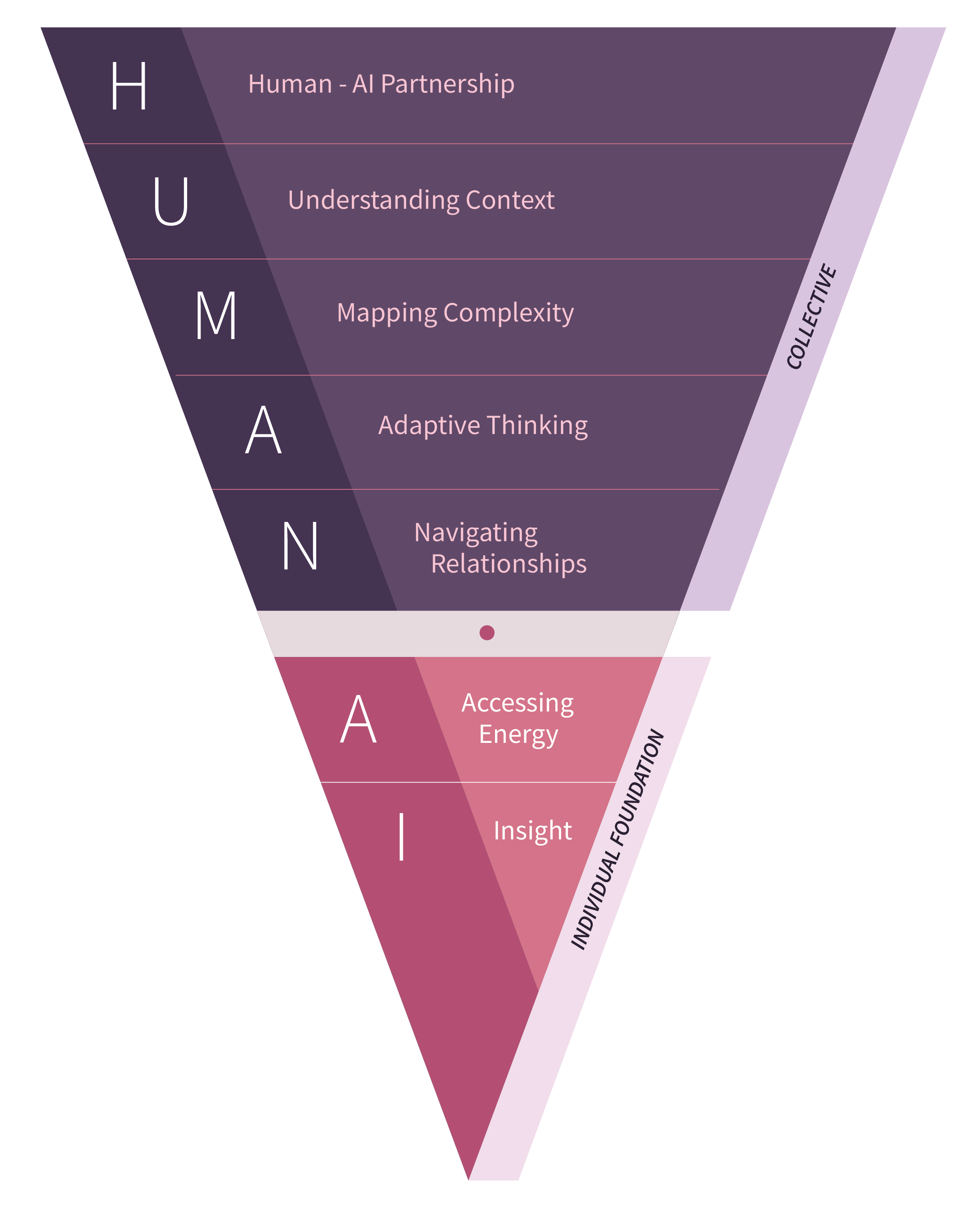
A research-backed diagnostic and development programme that measures, builds, and benchmarks the seven human dimensions that determine whether your workforce performs in an AI-driven world.
AI adoption is underway in most organisations. The pilots are running, the tools are in, and in some areas there are real productivity gains. But for most leaders responsible for the people side of this, it feels more fragmented than the headline numbers suggest. Adoption is uneven. Some leaders are leaning in, others are lagging behind. There is no shared standard for what good looks like when people work alongside AI. And the capabilities that actually determine whether it succeeds have not been defined, let alone built.
Stop treating your human dimensions as the nice-to-haves.
Rachel Garrett, Here for the Right Reasons
70%
of AI transformation failures stem from people and process, not technology. The bottleneck is almost never the tool.
McKinsey, 2023
The risk is not whether AI is adopted or not, but if it is adopted evenly and effectively. System-wide capability will always beat pockets of excellence.
The Human.AI Operating System
Seven dimensions. One irreplaceable advantage.
Traditional leadership programmes treat human capability as a skills gap to close. It is not. These are dimensions to protect and build conditions around. The distinction matters, because the response is completely different.
Grounded in neuroscience, global workforce research, and 25 years of real-world experience leading people through high-stakes transformation. Each dimension is irreplaceable by AI, developable through deliberate practice, measurable before and after, and linked to demonstrable organisational outcomes.
HUMAN: the five collective, outward-facing dimensions
.AI: the two individual foundation dimensions. Everything else rests on these.
HUMAN: collective layer
Every dimension was selected against four criteria: enduring, science-backed, developable through practice, and linked to measurable organisational outcomes.
Collective
H
Human-AI Partnership
Am I directing AI, or is it directing me?
Directing AI with intention. Knowing when to trust its output, when to override it, and how to amplify human judgement through it rather than replace it. This is fundamentally about cognitive agency: maintaining your own reasoning in a world where it is increasingly easy to outsource it.
AI adoption lags most in organisations where human agency is not actively cultivated alongside the technology (OECD, 2024). Only 13% of the skills employers value most have meaningful AI exposure (WEF/Indeed, 2025).
Neuroscience: Research on cognitive offloading (Sparrow et al., Science, 2011) shows that when we outsource reasoning to tools, the relevant neural pathways weaken. The dimension being built here is metacognition, the prefrontal ability to monitor your own thinking and re-engage your own judgement deliberately.
WEF / Indeed (2025): GenAI analysis of 2,900 granular work skills shows that the capabilities employers value most (empathy, leadership, curiosity) have only 12.7% AI transformation potential. The skills that direct AI are precisely those least susceptible to replacement by it.
Ethan Mollick, Co-Intelligence (2024): The leaders who thrive are those who develop clear judgement about where human thinking is irreplaceable, and act accordingly. AI is confident but not always correct. Humans are the critical validators.
HBR, 1,500 firms (2026): The largest performance gains from AI occur when humans and AI work together, not when either operates alone. Preserving human agency (the felt sense of being in the driver's seat) is identified as a design requirement, not a nice-to-have.
Collective
U
Understanding Context
Can I read what no algorithm can?
Reading the environment accurately. Sensing risk before it crystallises, understanding what is not being said, and exercising the judgement that no algorithm can replicate. AI can process vast amounts of data. It cannot read a hesitation in a meeting, interpret a pattern of behaviour, or know whether a technically correct decision is the wrong one for this organisation at this moment.
Most significant risk events are preceded by someone misreading their environment, or not reading it at all. AI can process data but cannot read what is actually happening in a room, a relationship, or an organisation.
Neuroscience: The prefrontal cortex integrates information from multiple domains to produce contextual understanding. This requires theory of mind (modelling others' intentions), embodied pattern recognition, and the insula's role in interoception and social awareness. Rebecca Saxe (MIT, 2003) identified the right temporoparietal junction as the primary neural substrate for mentalising (attributing beliefs and intentions to others). Antonio Damasio's somatic marker hypothesis shows the brain uses bodily signals to constrain judgement under uncertainty. These functions are trainable, and they degrade under threat and cognitive load.
FMA / APRA regulatory reviews: NZ and Australian conduct and culture reviews found that leadership failures were not caused by malicious intent but by leaders not reading their organisational environment well enough to catch problems early. The FMA identified tone from the top as the highest-leverage intervention point, a direct application of this dimension.
Gary Klein, Sources of Power (1998): A 20-year study of expert decision-making in high-stakes environments found that experts under pressure use recognition-primed decision-making: they read the situation, pattern-match against experience, and act. Contextual judgement is a practised skill built through experience with feedback.
Philip Tetlock, Superforecasting (2015): People who read context well share specific learnable habits: actively open thinking, calibration to uncertainty, and updating on new evidence. Most poor contextual readers have a single dominant explanatory framework and filter everything through it.
Collective
M
Mapping Complexity
Can I see the system, not just the problem?
Seeing how the parts of a system connect. Sensing patterns and second-order effects. Influencing outcomes across boundaries, not just within a direct span of control. Building structures that outlast individuals and making decisions that account for how a system actually works.
Systems thinking is in the top 10 fastest-growing skills globally (WEF Future of Jobs, 2025). 70% of AI transformation failures stem from people and process, not technology (McKinsey).
Neuroscience: Systems thinking draws on the prefrontal cortex's capacity for abstract reasoning, future projection, and integration of information across domains, precisely the functions that are most human and least automatable. Executive function research (Diamond, 2013) identifies cognitive flexibility and working memory as prerequisites for systems-level reasoning. Both are trainable.
McKinsey (2023): 70% of AI transformation failures are people and process failures, a deficit in systems-level thinking about how work actually changes when technology is introduced.
Liz Wiseman, Multipliers (2010): Research across 150+ leaders on four continents found that leaders who see intelligence as distributed across a system, rather than concentrated at the top, generate measurably better outcomes: more done with fewer resources, stronger retention, higher innovation.
Stanley McChrystal, Team of Teams (2015): The leader's role shifted from decision-maker to "gardener", creating the conditions in which distributed intelligence can operate at speed. The M dimension is precisely this ability to see the whole system and design for intelligence to flow through it rather than bottleneck at the top.
Collective
A
Adaptive Thinking
Do I find possibility in disruption, or just survive it?
Maintaining cognitive flexibility and creative problem-solving under genuine uncertainty. Not just coping with change, but finding new possibilities within it. Includes resilience (recovering from setbacks), reframing (finding new interpretations), and tolerance for ambiguity.
Resilience, flexibility, and agility rank first or second in employer demand, above AI literacy and technical skills. The single biggest differentiator between growing and declining job roles (WEF, 2025).
Neuroscience: Neuroplasticity (the brain's capacity to rewire in response to experience) is the biological foundation (Doidge, The Brain That Changes Itself). The anterior cingulate cortex plays a key role in detecting conflict and initiating cognitive flexibility. Carol Dweck's growth mindset research bridges neuroscience with behaviour: believing that capacity is growable activates different neural responses to challenge and failure. This is trainable through deliberate practice.
Kelly McGonigal, The Upside of Stress (2015): A study tracking 30,000 adults over eight years found that high stress increased the risk of death by 43%, but only for those who believed stress was harmful. People who experienced high stress but did not view it as dangerous had the lowest mortality of any group. Reframing is a trainable cognitive skill with measurable biological consequences.
WEF New Economy Skills (2025): Human-centric skills including resilience are "fragile": during the pandemic, interpersonal interaction skills fell more than 5% below 2019 levels, and no human-centric skills had returned to pre-pandemic baselines by 2025. Building and protecting these dimensions requires deliberate practice, not assumption.
Collective
N
Navigating Relationships
Do I build the trust that makes teams perform?
Building genuine trust. Practising empathy and active listening. Creating the conditions for psychological safety in teams. Goes beyond interpersonal warmth: this is the deliberate, skilled use of relationship to enable collective performance.
Psychological safety is the single strongest predictor of team effectiveness (Google Project Aristotle). High-trust organisations outperform low-trust ones by 50% in retention, 76% in engagement, and 50% in productivity (Paul Zak, Claremont).
Neuroscience: The social brain (including the mirror neuron system, the oxytocin/vasopressin system, and the default mode network) is specifically wired for social cognition. Daniel Goleman identified social awareness and relationship management as distinct, trainable skills. Daniel Siegel's interpersonal neurobiology shows that the quality of our relationships literally shapes brain structure and neural regulation capacity. Trust releases oxytocin, which increases collaboration, empathy, and willingness to take risks, all conditions for high performance.
Google Project Aristotle: A two-year study of 180+ Google teams found psychological safety (the belief that one can speak up without fear of punishment) to be the single strongest predictor of team effectiveness. It outperformed every other factor, including who was on the team.
Amy Edmondson, Harvard Business School: The highest-performing teams reported more errors, not fewer. Not because they made more mistakes, but because they felt safe enough to speak up. Three leadership behaviours create safety: framing work as learning, inviting participation with genuine questions, and responding productively to bad news.
Paul Zak, Claremont Graduate University: High-trust organisations outperform low-trust ones by 50% in retention, 76% in engagement, and 50% in productivity. Trust is not a soft outcome. It is a measurable performance input.
.AI: individual foundation. Everything else rests on these.
Individual foundation
.A
Accessing Energy
Am I protecting my capacity, or running on empty?
Managing energy deliberately. Protecting cognitive performance, recovering from depletion, and sustaining high performance over time without burning out. In an AI-driven world, the pressure to be always available intensifies this challenge. The question is not why a leader cannot push harder. The question is what conditions are shaping their capacity right now. The leaders who perform best over time actively protect the conditions that make their best thinking possible.
Proactive investment in employee brain health could increase global GDP by up to 12% and generate $11.7 trillion in economic value (WEF, 2026). The prefrontal cortex, the seat of judgement and empathy, is the first casualty of depletion.
Neuroscience: The brain has two primary operating modes: fast, reactive threat-scanning and slow, deliberate analytical reasoning. Sustained stress jams the switch, trapping leaders in a narrowed defensive state. Dan Siegel's window of tolerance (The Developing Mind) describes the range within which the brain functions optimally: learning, connecting, adapting. The practice of Accessing Energy is the practice of maintaining and returning to that window.
Prefrontal cortex: Judgment, empathy, and systems thinking degrade fastest under chronic stress, precisely the functions most demanded of leaders. The default mode network, where integration and meaning-making happen, requires genuine disengagement to function. Leaders who never fully stop are not working at their best; they are preventing their brains from doing the work that cannot happen in constant activation.
Nature Scientific Reports (2025): High cognitive strain correlates with measurable loss of white-matter integrity. Leaders under sustained pressure are operating with degraded neural infrastructure.
ScienceDirect (2024): Prolonged stress alters the prefrontal cortex and hippocampus, the regions critical for empathy, decision-making, and perspective-taking. The functions most demanded of leaders are the first to degrade.
Nicholas Janni, Leader as Healer (2022, Business Book of the Year): "Our thinking, our feeling, and our sensing are now separate. They don't operate as a coherent unit." The leader who has lost access to their physical and emotional intelligence is operating from a fraction of their full capacity.
Individual foundation
.I
Insight
Do I know who I am under pressure?
Knowing yourself accurately, including strengths, blind spots, values, and triggers. Choosing your response rather than defaulting to reaction. In an age of artificial intelligence, the most important I is still the human one. Self-awareness is what makes every other dimension possible.
Leaders with high self-awareness deliver 22% higher revenue growth and 34% higher profitability (Korn Ferry). 95% of people believe they are self-aware; only 10-15% actually are (Tasha Eurich, Insight).
Neuroscience: Self-awareness is grounded in activity across the anterior insula (interoception and bodily self-awareness), the medial prefrontal cortex (self-referential thinking), and the anterior cingulate cortex (error monitoring and emotional regulation). These networks are trainable. They are the same networks that allow leaders to regulate their response under pressure rather than react from habit.
Tasha Eurich, Insight (2017): Two types of self-awareness exist and do not reliably correlate: internal (knowing your own values, passions, and patterns) and external (accurately understanding how others perceive you). Leaders typically overinvest in one at the expense of the other. Highly self-aware people ask "what" questions rather than "why", which triggers rumination. "What is happening and what do I want to do about it?" produces a clear answer.
Korn Ferry: Leaders with high self-awareness deliver 22% higher revenue growth and 34% higher profitability, making it one of the highest-value leadership dimensions on commercial metrics.
Robert Kegan and Lisa Laskow Lahey, Immunity to Change (2009): Adults resist change not through lack of willpower but through unconscious competing commitments. 30 years of developmental research shows that surfacing these hidden dynamics is the mechanism of real growth. Adults move through stages of cognitive complexity, and each stage enables qualitatively different leadership.
Human.AI OS. Trademark registration in progress.
How it works
Four steps. Measurable results.
1
Diagnose
A research-backed assessment across all seven dimensions. Scenario-based, not tick-boxes. Designed to hold up under scrutiny from your most senior leaders. Individual and organisational deployment fully managed.
2
Understand
Individuals receive a personalised dimension profile with strengths, gaps, and development pathways. Your People Team gets an aggregated view across teams, departments, and the organisation as a whole.
3
Develop
Targeted development pathways for each dimension. Facilitated masterclasses, peer learning circles, and self-directed application in real work contexts. Delivered remotely, designed to work at scale.
4
Measure
Reassess at 6 and 12 months. Track dimension shifts at individual, team, and organisational level. Demonstrate that development investment is shifting capability, not just satisfaction scores.
A note on where we are. We are currently working with a select group of pilot organisations before full platform launch. This means you get the diagnostic rigour and development quality of the full programme, with the additional benefit of helping shape what gets built. Pilot clients are founding data partners. That is a premium position, not a limitation.
The impact
What this means for your organisation.
See what you cannot see today.
Engagement surveys and performance reviews do not measure the dimensions that predict future performance. This diagnostic does, at individual, team, and organisational level.
Move from gut feel to evidence.
Every individual gets a personalised dimension profile with strengths, gaps, and development pathways. Your People Team gets the aggregated view.
Connect capability to business outcomes.
Link dimension data to retention, engagement, innovation metrics, and AI adoption rates. Present it in a format your board and executive committee can act on.
Track real progress.
Reassess at 6 and 12 months. Demonstrate that your development investment is shifting capability, not just producing feedback scores.
Make your AI investment work.
AI adoption succeeds or fails on the human dimensions that support it. Human-AI Partnership is a dedicated dimension in the diagnostic. We measure exactly what drives adoption.
Name and manage risk before it materialises.
Understanding Context and Navigating Relationships map directly to conduct risk, governance risk, and culture risk. The diagnostic gives you the language and the data to act early.
For chief people officers
What we get asked most.
Q
Is our data private and secure?
Individual assessment data is fully private. Only anonymised, aggregated results are used in reporting. Data is never sold or shared with third parties. This is a foundational design principle, not an afterthought.
Q
How does this integrate with our existing systems?
The diagnostic runs as a standalone experience and can be discussed for integration with your existing LMS. Your IT team does not need to rebuild anything.
Q
What is the commercial model?
Modular engagement. The diagnostic is the starting point. Development programmes are activated based on diagnostic results, so investment is targeted at the dimensions with the greatest gap and the greatest commercial impact.
Q
How do we prove ROI to the board?
Before-and-after dimension measurement, combined with business outcome correlation across retention, engagement, innovation, and AI adoption. The diagnostic is the business case.
Q
What is the science behind the seven dimensions?
The Human OS draws on neuroscience research, WEF Future of Jobs data, and enterprise performance data from Korn Ferry, McKinsey, and Deloitte. Every dimension was selected for being enduring, science-backed, developable in practice, and observable in behaviour.
Q
Can you accommodate our organisation's specific context?
Yes. The Human OS is research-grounded and consistent, but masterclass delivery and development pathways are designed to reflect the specific context of your organisation, sector, and workforce. We have particular depth in financial services, technology, and New Zealand and Pacific organisations.
Who we are
Built by people who have done this.
Joe Consedine
Co-creator, Human.AI Operating System
Joe Consedine is one of Aotearoa New Zealand's leading voices on human leadership, inclusion, and transformation. He works with organisations locally and globally to build leadership capability, strengthen culture, and drive meaningful change in complex environments.
Joe has partnered with New Zealand's top CEOs and Board Chairs through Champions for Change and previously led the accounting profession's first inclusion strategy at Chartered Accountants ANZ. His 20-year career in leadership has focused on building the human capabilities required for organisations to navigate complexity, work effectively with technology, and sustain performance in the future of work.
Rachel Garrett
Co-creator, Human.AI Operating System
Rachel spent the better part of a decade at Shopify across three distinct eras: part of a pioneering team that made remote-first work before the rest of the world thought it was possible, through rapid global scale building teams of more than 800 people across twelve countries, and into the AI transformation. She has implemented AI at international scale, AI that has changed business results.
Before Shopify, she was part of the senior leadership team at Trade Me, and before that, operational and change management roles across financial services and health. More than two decades at the intersection of people, performance, and change, in organisations moving fast, under pressure, through uncertainty. She is an accredited coach and a trained mediator.
Get started
Ready to see where your organisation stands?
We are working with a select group of pilot organisations ahead of the full programme launch. This is not another AI literacy session. It starts with knowing where your organisation actually stands.
If you lead people-strategy or are accountable for workforce capability, we would like to talk.